|
||||||||
| MASM | MASM Help | Using MASM | Tutorial | MIPS Card | MIPS Guide | |||
|---|---|---|---|---|---|---|---|---|
| MIPS Instruction Set I | MIPS Instruction Set II | MIPS Quick Reference | MIPS Supplement | MIPS Tutorial | ||||
| ARM | ARM help | Using ARM | ||||||
| General Information | Discord | EE/CS Wiki | EITS | Textbook | Stack Overflow | |||

| Syllabus: Fall 2026 | Credit hours: 3 | |
| Class times: 10:10am – 11:00pm, MoWeFr | Classroom: Harrington 108 | |
| Class # (on-campus: 250-01): 36013 | Class # (on-line: 250-02): 36014 | |
| Instructor: Wen-Chen Hu (my teaching philosophy) | Office: Upson II 366K | |
 :
https://und.zoom.us/j/2489867333 :
https://und.zoom.us/j/2489867333
|
 Email: wenchen@cs.und.edu Email: wenchen@cs.und.edu
|
|
| Office hours: 02:30pm – 04:00pm, MoWeFr | ||
Synchronous class delivery: The class lectures will be delivered synchronously via https://und.zoom.us/j/2489867333, and the Zoom video will be posted on the Blackboard afterwards. Students can watch the video clips anytime they want.
Textbook: Assembly Language for x86 Processors, 7th ed., Kip Irvine, Pearson, ISBN: 0133769402
†There is no specific textbook adopted for the assembly language discussed in this course because the lecture notes and the above links provide enough information for us to use.)
Lecture notes: Other than the textbook, award-winning, interactive, complementary, and abridged lecture notes (based on the textbook and other online documents and user manuals) and detailed and precise class instructions will be provided. Collectively, the lecture notes and instructions are more like a small book, which supplies much more information than regular notes do and makes the subject studies much easier. Students will not have problem learning the subjects or taking the exams after studying them and doing the homeworks and programming exercises.
| Grading: |

|
Announcements:
- Updated constantly: Class notes
- Monday, January 12: Register this course via Course Registration.
Tentative Schedule:
Week |
Class | Topic | Reading | Where | |||||
|---|---|---|---|---|---|---|---|---|---|
| 0 | |||||||||
| 0.1 A computer career | |||||||||
| 0.2 Data research | |||||||||
| 0.3 Data technologies | |||||||||
| 1 | 01/13 01/14 01/15 |
1. Introduction to CSCI 250 | Chapter 1 | ||||||
| 1.1 Course outline | |||||||||
| 1.2 Historical perspective | 1.12 |  |
|||||||
| 1.3 Programming language generations | |||||||||
| 1.4 A language processing system | |||||||||
| 2 | 01/20 01/21 01/22 |
2. Programming Exercise I | Chapter 1 | ||||||
| 2.1 Below your program | 1.1-1.3 | ||||||||
| 2.2 Under the covers | 1.4 | ||||||||
| 2.3 Memory technologies | 1.5 | ||||||||
| 2.4 Processor technologies | 1.5 | ||||||||
| 01/22 |
Last day to add a course or drop without record Last day to add audit or change to/from audit Last day to receive a refund on a dropped class Drops after the last day to add will appear on a transcript. |
||||||||
| 01/19 |
|
||||||||
| 3 | 01/26 01/27 01/28 01/29 |
3. Introduction to Assembly Languages | Chapter 1 | ||||||
| 3.1 Performance | 1.6 | ||||||||
| 3.2 The power wall | 1.7 | ||||||||
| 3.3 The sea change | 1.8 | ||||||||
| 3.4 Real stuff | 1.9 | ||||||||
| 4 | 02/02 02/03 02/04 02/05 |
4. Basic Concepts | App. A & Ch. 2 | ||||||
| 4.1 Programming Exercise I | |||||||||
| 4.2 MARS simulator | A.2-A.4 | ||||||||
| 4.3 MIPS CPU | A.9 | ||||||||
| 4.4 MIPS assembly language | A.10 | ||||||||
| 5 | 02/09 02/10 02/11 02/12 |
5. |
App. A & Ch. 2 | ||||||
| 5.1 Operations and operands | 2.1-2.3 | ||||||||
| 5.2 Data representations | 2.4 | ||||||||
| 5.3 Signed and unsigned numbers | 2.4 | ||||||||
| 5.4 Representing instructions in the computer | 2.5 | ||||||||
| 6 | 02/17 02/18 02/19 |
6. |
App. A & Ch. 2 | ||||||
| 6.1 Memory usage | A.5 | ||||||||
| 6.2 Logical operations | 2.6 | ||||||||
| 6.3 Instructions for making decisions | 2.7 | ||||||||
| 6.4 Supporting procedures in computer hardware | 2.8 | ||||||||
| 02/16 |
|
||||||||
| 7 | 02/23 02/25 02/26 |
7. |
App. A & Ch. 2 | ||||||
| 7.1 Procedure call convention | A.6 | ||||||||
| 7.2 Communicating with people | 2.9 | ||||||||
| 7.3 MIPS addressing for 32-bit immediates and addresses | 2.10 | ||||||||
| 7.4 Translating and starting a program | 2.12 | ||||||||
| 02/24 (no class) |
|
||||||||
| 8 | 03/02 03/03 03/04 03/05 |
8. |
Chapter 3 | ||||||
| 8.1 Introduction | 3.1 | ||||||||
| 8.2 Addition and subtraction | 3.2 | ||||||||
| 8.3 Multiplication | 3.3 | ||||||||
| 8.4 Division | 3.4 | ||||||||
| 9 | 03/09 – 03/13 |
|
|||||||
| 10 | 03/16 03/19 |
10. |
Chapter 3 | ||||||
| 10.1 Floating point representation | 3.5 | ||||||||
| 10.2 Floating-point addition and subtraction | 3.5 | ||||||||
| 10.3 Floating-point multiplication | 3.5 | ||||||||
| 10.4 The guard, round, and sticky bits | 3.5 | ||||||||
| 03/17 03/18 (no classes) |
|
||||||||
| 11 | 03/23 03/24 03/25 03/26 |
11. |
Chapter 4 | ||||||
| 11.1 Introduction | 4.1 | ||||||||
| 11.2 Logic design conventions | 4.2 | ||||||||
| 11.3 Building a datapath | 4.3 | ||||||||
| 11.4 Creating a single datapath | 4.3 | ||||||||
| 12 | 03/30 03/31 04/01 04/02 |
12. |
Chapter 4 | ||||||
| 12.1 A simple implementation scheme | 4.4 | ||||||||
| 12.2 Operation of the datapath | 4.4 | ||||||||
| 12.3 The ALU control | 4.4 | ||||||||
| 12.4 Designing the main control unit | 4.4 | ||||||||
| 13 | 04/07 04/08 04/09 |
13. |
Chapter 4 | ||||||
| 13.1 Pipelining overview | 4.6 | ||||||||
| 13.2 Pipeline hazards | 4.6 | ||||||||
| 13.3 Pipelined datapath | 4.7 | ||||||||
| 13.4 Pipelined control | 4.7 | ||||||||
| 04/10 |
Last day to change to or from S/U grading Last day to change to or from audit grading Last day to drop a full-term course or withdraw from school |
||||||||
| 04/06 |
| ||||||||
| 14 | 04/13 04/15 04/16 |
14. |
Chapter 4 | ||||||
| 14.1 Data hazards | 4.8 | ||||||||
| 14.2 Forwarding versus stalling | 4.8 | ||||||||
| 14.3 Control hazards | 4.9 | ||||||||
| 14.4 Dynamic branch prediction | 4.9 | ||||||||
| 04/14 (no class) |
|
||||||||
| 15 | 04/20 04/21 04/22 04/23 |
15. |
Chapter 5 | ||||||
| 15.1 Introduction | 5.1 | ||||||||
| 15.2 Memory technologies | 5.2 | ||||||||
| 15.3 The basics of caches | 5.3 | ||||||||
| 15.4 Accessing a cache | 5.3 | ||||||||
| 16 | 04/27 04/28 04/29 04/30 |
16. |
Chapter 5 | ||||||
| 16.1 Measuring cache performance | 5.4 | ||||||||
| 16.2 Improving cache performance | 5.4 | ||||||||
| 16.3 Multi-level cache | 5.4 | ||||||||
| 16.4 Review questions | 5.4 | ||||||||
| 17 | 05/04 05/05 05/06 05/07 |
17. |
Chapter 5 | ||||||
| 17.1 Virtual memory | 5.7 | ||||||||
| 17.2 TLB | 5.7 | ||||||||
| 17.3 A common framework | 5.8 | ||||||||
| 17.4 Wrapping up | |||||||||
| 18 | 05/12 |
|
|||||||
| 19 | 05/19 | Grades posted before noon, Tuesday |






Though most likely you will not be asked to design computers during your career, a computer scientist or an IT worker must be familiar with the following four foundations of computer science:
- Programming languages,
- Computer architecture,
- Operating systems, and
- Computer algorithms and theories.

Instructor’s qualification:
The instructor has been teaching computer architecture for more than 15 years, so he is well familiar with the topics.
In addition, he taught an assembly-language course for 7 years and designed and implemented a POPLOG virtual machine for which both LISP and PROLOG compilers generate code.
University of North Dakota Course Description (CSCI 250) —
Introduction to machine language and assembly language programming.
Concepts of assembly language and the machine representation of instructions and data of a modern digital computer are presented.
Requires students to practice assembly language programming techniques on ARM and Intel x86 architectures.
Computer Architecture from Wikipedia —
Computer architecture in computer engineering is the conceptual design and fundamental operational structure of a computer system.
It is a blueprint and functional description of requirements and design implementations for the various parts of a computer, focusing largely on the way by which the central processing unit (CPU) performs internally and accesses addresses in memory.
Assembly Language from webopedia.com —
Assembly language is once removed from a computer’s machine language.
Machine languages consist entirely of numbers and are almost impossible for humans to read and write.
Assembly languages have the same structure and set of commands as machine languages, but they enable programmers to use names instead of numbers.
Each type of CPU has its own machine language and assembly language, so an assembly language program written for one type of CPU will not run on another.
In the early days of programming, all programs were written in assembly language.
Now, most programs are written in a high-level language such as FORTRAN or C.
Programmers still use assembly language when speed is essential or when they need to perform an operation that isn’t possible in a high-level language.
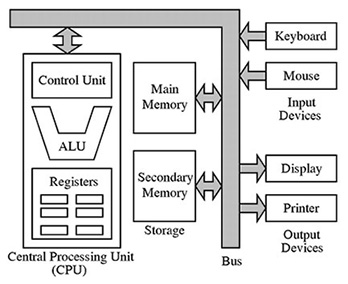
A System Structure of Basic Computer Systems —
|

|
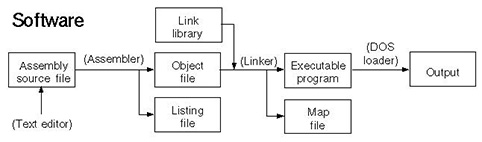
An Assemble-Link-Execute Cycle —
|

|