|
||||||||
| Software/Tool | W3Schools | W3C | C# | .NET | Visual Studio | |||
|---|---|---|---|---|---|---|---|---|
| HTML & CSS | HTML help | HTML tutorial | CSS help | CSS tutorial | ||||
| ASP.NET | ASP.NET help | ASP.NET | Overview | VS Express | ||||
| SQL Server | SQL Server help | SSMS help | SQL Server | TutorialsPoint | ||||
| General Information | Discord | EE/CS Wiki | EITS | UND help | Stack Overflow | |||

| Syllabus: Fall 2026 | Credit hours: 3 | |
| Class times: 04:40pm – 05:30pm, MoWeFr | Classroom: Harrington Hall 217 | |
| Class # (on-campus: 490-04): 36020 | Class # (on-line: 490-05): 36021 | |
| Instructor: Wen-Chen Hu (my teaching philosophy) | Office: Upson II 366K | |
 :
https://und.zoom.us/j/2489867333 :
https://und.zoom.us/j/2489867333
|
 Email: wenchen@cs.und.edu Email: wenchen@cs.und.edu
|
|
| Office hours: 12:30pm – 02:00pm, MoWeFr | ||
Prerequisite: Consent of the instructor
Synchronous class delivery: The class lectures will be delivered synchronously via https://und.zoom.us/j/2489867333, and the Zoom video will be posted on the Blackboard afterwards. Students can watch the video clips anytime they want.
Lecture notes: No textbook will be used. Instead award-winning, interactive, informative, and practical lecture notes (based on W3Schools, Microsoft ASP.NET Core, and other online documents and user manuals) and detailed and precise class instructions will be provided. Collectively, the lecture notes and instructions are more like a small book, which supplies much more information than regular notes do and makes the subject studies much easier. Students will not have problem learning the subjects or taking the exams after studying them and doing programming exercises.
| Grading: |

|
Announcements:
- Updated constantly: Class notes
- Monday, August 24: Register this course via Course Registration.
Tentative Schedule:
Week |
Class | Topic | Due | Where | ||||
|---|---|---|---|---|---|---|---|---|
| 0 | 0. Computer Career and Data Research & Technologies | |||||||
| 0.1 A computer career | ||||||||
| 0.2 Data research | ||||||||
| 0.3 Data technologies | ||||||||
| 1 | 08/26 08/28 |
1. Introduction to CSCI 490 | ||||||
| 1.1 Course outline |  |
|||||||
| 1.2 Tentative schedule | ||||||||
| 1.3 Software to be used | ||||||||
| 2 | 08/31 09/02 09/04 |
2. Programming Exercise I | ||||||
| 2.1 Specifications | ||||||||
| 2.2 ASP.NET Core | ||||||||
| 2.3 SQL Server database | ||||||||
| 09/02 |
Last day to add a course or drop without record — 100% refund Last day to add audit or change to/from audit Last day to receive a refund on a dropped class Drops after the last day to add will appear on a transcript. |
|||||||
| 3 | 09/09 09/11 |
3. World Wide Web Programming | ||||||
| 3.1 Technologies for website building | ||||||||
| 3.2 World Wide Web programming | ||||||||
| 3.3 The WISA stack | ||||||||
| 09/07 |
|
|||||||
| 4 | 09/14 09/16 09/18 |
4. Microsoft ASP.NET Core Programming | ||||||
| 4.1 Models | ||||||||
| 4.2 Views | ||||||||
| 4.3 Controllers | ||||||||
| 5 | 09/21 09/23 09/25 |
5. ASP.NET: A Database Project | ||||||
| 5.1 Construction steps | ||||||||
| 5.2 Connecting to a database | ||||||||
| 5.3 Database processing embedded in ASP.NET | ||||||||
| 6 | 09/28 09/30 10/02 |
6. ASP.NET: Entity Framework (EF) Core | ||||||
| 6.1 Input fields | ||||||||
| 6.2 Radio buttons | ||||||||
| 6.3 Checkboxes | ||||||||
| 7 | 10/05 10/09 |
7. ASP.NET: Multiple Users | ||||||
| 7.1 Programming Exercise II | ||||||||
| 7.2 User model | ||||||||
| 7.3 Role model | ||||||||
| 10/07 (no class) |
|
|||||||
| 8 | 10/12 10/14 10/16 |
8. Databases and SQL | ||||||
| 8.1 Introduction to databases | ||||||||
| 8.2 SQL Server DBMS | ||||||||
| 8.3 SQL (Structured Query Language) | ||||||||
| 9 | 10/19 10/21 10/23 |
9. C# for ASP.NET | ||||||
| 9.1 Getting started with C# | ||||||||
| 9.2 C# code samples | ||||||||
| 9.3 C# data types and variables | ||||||||
| 10 | 10/26 10/28 10/30 |
10. C# for ASP.NET (Cont.) | ||||||
| 10.1 C# arrays | ||||||||
| 10.2 C# control structures | ||||||||
| 10.3 C# functions | ||||||||
| 11 | 11/02 11/04 11/06 |
11. HTML (HyperText Markup Language) | ||||||
| 11.1 Programming Exercise III | ||||||||
| 11.2 HTML syntax and tags | ||||||||
| 11.3 HTML examples | ||||||||
| 12 | 11/09 11/13 |
12. (X)HTML and XML | ||||||
| 12.1 XML | ||||||||
| 12.2 XHTML | ||||||||
| 12.3 HTML5 | ||||||||
| 11/13 |
Last day to change to or from S/U grading Last day to change to or from audit grading Last day to drop a full-term course or withdraw from school |
|||||||
| 11/11 |
| |||||||
| 13 | 11/16 11/20 |
13. CSS (Cascading Style Sheet) | ||||||
| 13.1 Programming Exercise IV | ||||||||
| 13.2 CSS basics and syntax | ||||||||
| 13.3 CSS fonts and lists | ||||||||
| 11/18 (no class) |
|
|||||||
| 14 | 11/23 | 14. CSS (Cascading Style Sheet) (Cont.) | ||||||
| 14.1 CSS box model and border | ||||||||
| 14.2 CSS pseudo- class and element | ||||||||
| 14.3 CSS navigation bar and images | ||||||||
| 11/25 11/26 11/27 |
| |||||||
| 15 | 11/30 12/02 12/04 |
15. The World Wide Web | ||||||
| 15.1 Introduction to the WWW | ||||||||
| 15.2 Internet addressing | ||||||||
| 15.3 Internet terminologies | ||||||||
| 16 | 12/07 12/09 |
16. Microsoft .NET | ||||||
| 16.1 Introduction to Microsoft .NET | ||||||||
| 16.2 Microsoft .NET | ||||||||
| 16.3 Web terms | ||||||||
| 17 | 12/16 |
|
||||||
| 18 | 12/22 | Grades posted before noon, Tuesday |




- AI/ML Engineer (average salary: $131,000)
- IT security specialist (not developer; average salary: $125,000)
- Mobile application developer (average salary: $133,000; Check CSCI 457)
- Technology manager (average salary: $171,000)
- Software engineer (average salary: $131,000)
- Computer systems analyst (not developer; average salary: $104,000)
- Web developer (average salary: $95,000)
- Video game designer (including developer; average salary: $99,000)
- Health information technician (average salary: $67,000)
- Database administrator/developer (average salary: $123,000)
However, without a proven track record, a computer/data-science graduate may face one of the highest unemployment rates (6.1%) because companies want employees to start contributing immediately according to Newsweek (05/24/2025). Computer/data science is different from many other disciplines (like electrical engineering). It is more like a professional school (such as culinary schools), which emphasizes practical works instead of subject studies. There are three kinds of computing personnel:
- Developers:
- Positions (plenty): Developers of front-end and back-end web pages, mobile apps, and all kinds of software
- Skills (more stable): Programming languages (such as C++ and Java), web programming, mobile app development, data processing and management including databases, and data structures & algorithms
- Practitioners:
- Positions (not many): Experienced personnel like data scientists, database or system administrators, security analysts, and network architects (more applications & configuration and less development)
- Skills (based on the needs of companies): Databases, data warehousing, data lake, Hadoop, MapReduce, Linux, SPSS, SAS, Cogno, Matlab, Tableau, etc.
- Researchers:
- Industrial positions (few and based on the needs of corporations): High quality personnel required for the advanced areas like artificial intelligence, security, computer vision, autonomous driving, and speech recognition
- Academic positions/trends (few and changed according to the government policies): ❓ ⇐ artificial intelligence ⇐ big data ⇐ high-performance computing ⇐ security ⇐ (mobile) networks
Remark I: Definitions, terminologies, and theories will be discussed minimally in this course. Instead practical works and programming knowledge will be emphasized and enforced.
Remark II: This is a fundamental web course using ASP.NET.
- For an advanced web course, check CSCI 457 Electronic/Mobile Commerce Systems using LAMP (Linux, Apache, MySQL, and PHP) and Android,
- For a database course, check DATA 520 Databases using Oracle databases and JDBC (Java Database Connectivity), and
- For an advanced database course, check CSCI 513 Advanced Database Systems using object-relational and embedded databases.
Remark III: Numerous web development tools and software have been proposed and keep emerging. The reason of using the latest ones is mainly because of hype since programming languages have no major breakthroughs since 1950s, and the application cores still require about the same level of heavy human works. Unfortunately, many IT managers do not realize this truth, but once you master one specific technology, learning another should not be difficult because all foundations are about the same.
Remark IV: Web, mobile, and database programming is a must for IT developers, and the only effective way to learn software development is practicing, instead of studying concepts or writing some testing programs.
No pain, no gain 😂
Instructor’s qualification: The instructor initiated a database-driven web system by using Perl and Sybase in 1997, when not many people were familiar with the web development. Ever since, numerous software and tools such as ASP.NET, LAMP, and Oracle have been used by him to build various web systems.
University of North Dakota Course Description (CSCI 490) —
An introduction to Microsoft .NET and World Wide Web programming for fundamental web content development.
Topics including Microsoft .NET concepts, World Wide Web basics, web system structures, technology survey, client-side languages such as (X)HTML, server-side languages such as ASP.NET and database processing, web-host connection, and web content design and development.
.NET from Wikipedia —
Commonly known as e-commerce, consists of the buying and selling of products or services over electronic systems such as the Internet and other computer networks.
Electronic Commerce Technology from IEEE TCEC —
The different technologies reflect the technical, organizational, and legal requirements of the different participants in electronic business transactions.
These technologies support one or more of the phases of an electronic business
transaction: planning, identification, negotiation, actualization, and post-actualization.
|
A Generic System Structure of a Database-Driven Web System — |
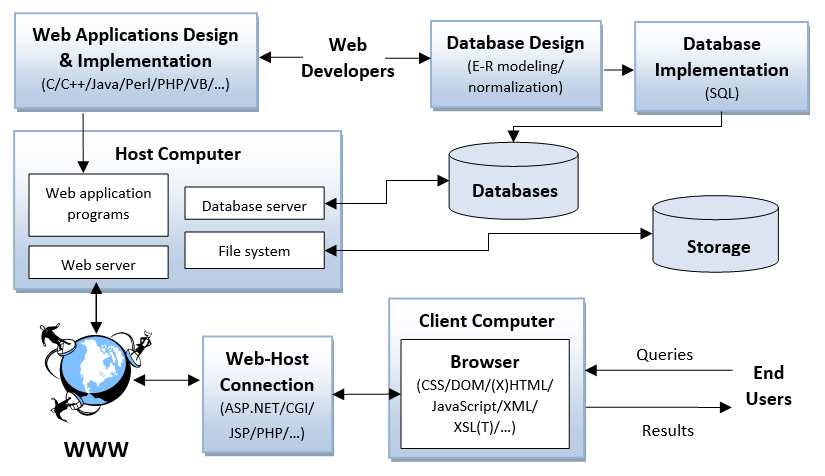
|
An Internet-Enabled and Mobile Database Course Sequence —
This is part of an Internet/mobile-enabled database course sequence offered by me:
CSCI 490 .NET and World Wide Web Programming
⇓
CSCI 457 Electronic and Mobile Commerce Systems
⇓
DATA 520 Databases
⇓
CSCI 513 Advanced Database Systems
⇓
CSCI 515 Data Engineering and Management
⇓
DATA 525 Data Engineering and Mining
- CSCI 490 (.NET and World Wide Web Programming) to build database-driven websites by using
- Microsoft SQL Server database,
- Microsoft ASP.NET,
- Microsoft C#,
- Microsoft .NET, and
- Microsoft Visual Studio.
- CSCI 457 (Electronic and Mobile Commerce Systems) to build electronic and mobile commerce systems by using
- Android programming,
- Android-server-database connection,
- (L) Linux operating system,
- (A) Apache web server,
- (M) MySQL database, and
- (P) PHP.
- DATA 520 (Databases) to build Internet/mobile-enabled database systems by using
- Android programming,
- Android-server-database connection,
- JDBC (Java Database Connectivity),
- Oracle database, and
- Relational database design and SQL.
- CSCI 513 (Advanced Database Systems) to build Internet-enabled and embedded database systems by using
- Android programming,
- Android SQLite embedded database,
- JDBC (Java Database Connectivity),
- Object-relational SQL and PL/SQL, and
- Oracle (an object-relational database).
- CSCI 515 (Data Engineering and Management) to build location-based services and data-mining systems to discover knowledge from a large set of data by using
- Android programming,
- Android Google APIs and Firebase database,
- Data mining and knowledge discovery,
- Information retrieval,
- Location-based services, and
- Smartphones and mobile handheld devices.
- DATA 525 (Data Engineering and Mining) to build Internet-enabled data-mining systems to discover knowledge from a large set of data by using
- Data mining and knowledge discovery,
- Internet-enabled Firebase database,
- Information retrieval, and
- Internet-enabled TensorFlow.