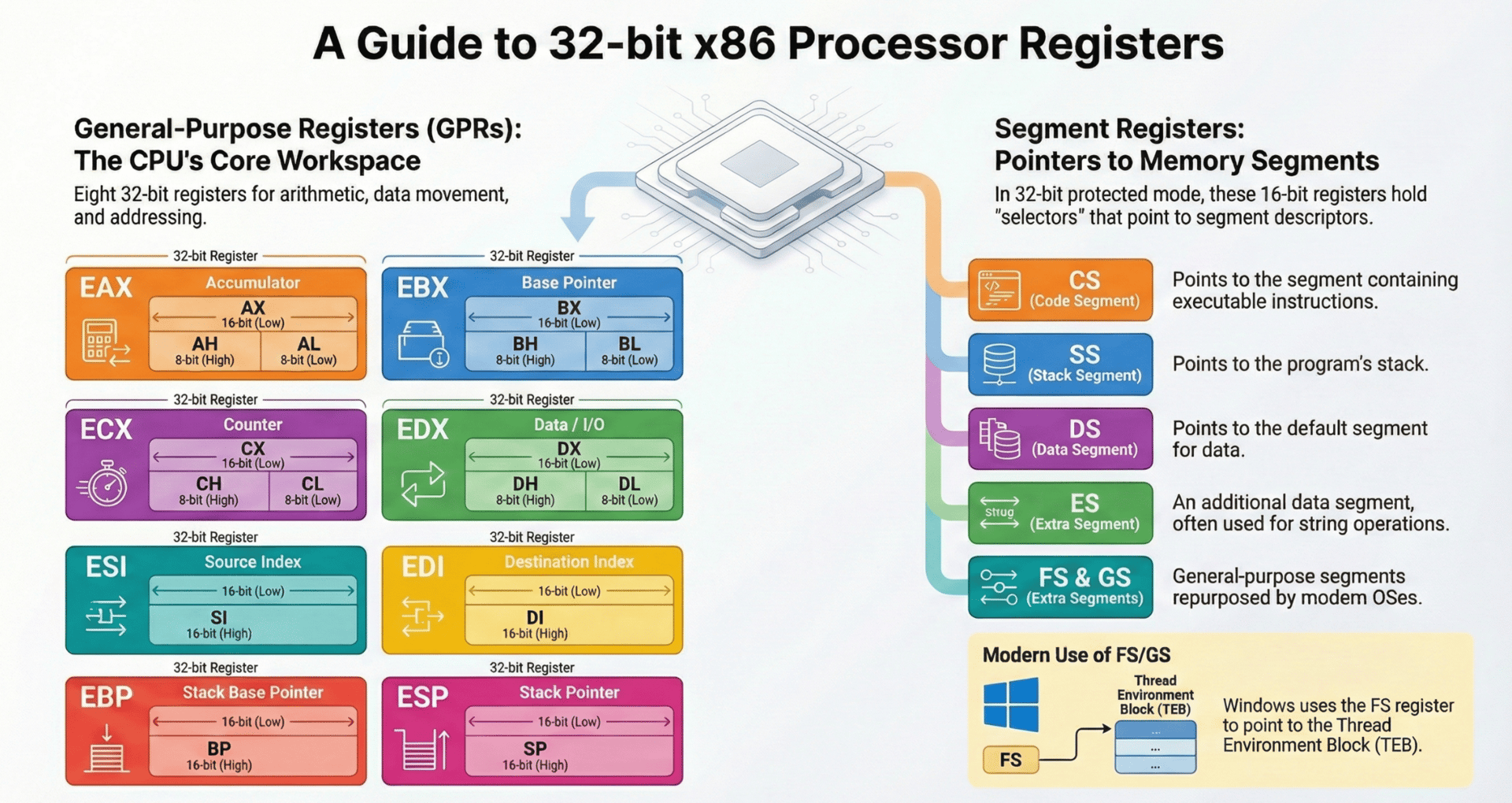
The word “general-purpose” means the registers could be used for many purposes. However, some registers used in the following ways will generate more efficient machine code:
- (Extended Accumulator Register), the primary accumulator, is used for operations involving input/output and most arithmetic. is automatically used by multiplication and division instructions.
- (Extended Base Register) is known as the base register since it is used as an index to extend addressing.
- (Extended Count Register) is know as the count register. It may contain a value to control the number of times a loop is repeated or a value to shift bits left or right. is used as a loop counter.
- (Extended Data Register) is known as the data register. Some input/output operations require its use, and multiply and divide operations that involve large values.
- / (Extended Base/Stack Pointer) manages stack frames, function calls, and local variables.
- / (Extended Source/Destination Index) used for high-speed string and memory data transfers.
- / (Extended Base/Stack Pointer) manages stack frames, function calls, and local variables.
|
“I just realized that ‘Let me check my calendar’ is the adult version of ‘Let me ask my mom.’” — Noelle Chatham |