Programming Language Generations (Cont.)
3rd Generation (High-Level Languages such as C, C++, and Pascal, 1950s)
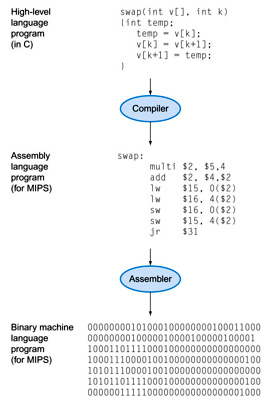
It provides some level of abstraction above assembly language.
These normally use statements consisting of English-like keywords such as “FOR,” “PRINT,” or “GOTO,” where each statement corresponds to several machine/assembly language instructions, whereas each assembly-language statement corresponds to one machine-language instruction.
It is much easier to program in a high-level language than in assembly language.
For example, assume that X and Y are integers.
X = (Y + 4) × 3;
This command could be translated to the following assembly commands:
mov eax, Y ; move Y to the EAX register
add eax, 4 ; add 4 to the EAX register
mov ebx, 3 ; move 3 to the EBX register
imul ebx ; multiply EAX by EBX
mov X, eax ; move EAX to X
4th Generation (Application-Specific Languages such as SQL, Cobol, and Prolog, 1950s)
The term refers to non-procedural high-level languages built around database systems.
For this kind of languages, the programmers tell the computers what to do, but not how to do it.
For example, a typical 4GL command is
FIND ALL RECORDS WHERE NAME IS "SMITH"
5th Generation (1980s)
A myth the Japanese spent a lot of money on.
In about 1982, METI (Ministry of Economy, Trade, and Industry) of Japan decided it would spend ten years and a lot of money applying artificial intelligence to programming, thus solving the software crisis.
The project spent its money and its ten years and in 1992 closed down.
Demonstration
Below is an SQL test area from W3Schools, which uses the well-known Northwind sample database.
The tables here are for read only because of the problem of embedding the scripts.
For a fully working example, check this by using Chrome.
|
|
The Database includes:
| Tablename | Record |
| Customers | 91 |
| Categories | 8 |
| Employees | 10 |
| OrderDetails | 518 |
| Orders | 196 |
| Products | 77 |
| Shippers | 3 |
| Suppliers | 29 |
|
This SQL-Statement is not supported in the WebSQL Database.
The example still works, because it uses a modified version of SQL.
Your browser does not support WebSQL.
Your are now using a light-version of the Try-SQL Editor, with a read-only Database.
If you switch to a browser with WebSQL support, you can try any SQL statement, and play with the Database as much as you like. The Database can also be restored at any time.
Our Try-SQL Editor uses WebSQL to demonstrate SQL.
A Database-object is created in your browser, for testing purposes.
You can try any SQL statement, and play with the Database as much as you like. The Database can be restored at any time, simply by clicking the "Restore Database" button.
W3C WebSQL
WebSQL stores a Database locally, on the user's computer. Each user gets their own Database object.
WebSQL Browser Support
WebSQL is supported in Chrome, Safari, and Opera.
If you use another browser you will still be able to use our Try SQL Editor, but a different version, using a server-based ASP application, with a read-only Access Database, where users are not allowed to make any changes to the data.